|


Once every
10-20 years, something revolutionary comes along. This is especially
true in music. As of late, Artificial Intelligence (AI) is the new
buzz-word. While often used as a mere marketing gimmick, AI is
proving daily that it is the next game-changing technology. And now, Spectrelayer
is here. This new service has nearly a decade of development & as much
lead time. It's time to let it out of the proverbial "lab".
You know that over 70% of music sales are currently what
is called "Older Genres". Because those artists from the 70's & 80's
are also the favorites of the post-"Boomer" generation, a unique
sales window is open for about 10-20 more years. You see, the only
thing better than selling a record once is to sell it twice. And the
people who might buy it a 2nd time are those who purchased the
original release. There is only (1) reason that somebody would do
that: An audibly superior re-release of their favorite material
becomes available.
When companies began to sell digital re-releases of previously
analog material - they realized the simple truth of what I'm talking
about: Compact Discs replaced tape & vinyl with a roar at the
cash-register! But what has the recording industry offered since the
digital revolution became par? Remasters. A "Remaster" is where
musical classics (art) are reissued after having been damaged with
"loudness-war" mentality & relabeled advertising it. That's not true
every time - but it happens enough that it is now a stereotype. And
such "remasters" along with "Hi-Res Digital", MQx, "snake-oil 2.0",
etc. have damaged the reputation of the music industry. Spectrelayer
is different - clearly, audibly superior: POSTmastering.
As the process
developer, a
polymath &
autodidact;
-I wish that Spectrelayer was a simple black box that I could pour a
recording in on one side & have it emerge processed on the other
with everything perfectly ready for return-submission. But in the world of quality art - that's not how things
work. Spectrelayer still requires a human with ears & expertise
to review the content & make adjustments. And
as anyone who works with AI will tell you: There are artifacts &
that must occasionally be addressed. Just as sow's ears cannot be easily made
into proverbial silk-purses; -Neither can challenging audio be easily
reconstructed without an engineer's ears meticulously guiding the
process. And because engineers who understand the workings of a DAW
-AND- integrating such with proprietary technologies (such as AI) -
are scarcer than honest politicians; - He who hesitates had better
be prepared to wait in line once the proverbial trigger gets pulled.
NOW is the day to begin your relationship with Spectrelayer as a
client. Test drive us w. our free & discount offers!
Q
& A Section:
|
Questions & Answers about the Service that is giving new life to
recordings of great music! |
Q:
What Inspired the Spectrelayer Name?
A:
The root term in the
Spectrelayer name is:
SPECTRE
(spek-tər)-
The badass European spelling for a
term
associated with a ghost or spirit (one usually deemed to be
startling or attention grabbing). And this is the goal of the
Spectrelayer process; -To seize & focus attention of the listener by
remarkably improving the audio. Over 2000 years ago, Rabbi Yeshua
Ben Yoseph said that the rocks themselves could speak unspoken
truths (Lk 19:40),
& here we are - in a day when microprocessors (made of purified
mineral crystals - rocks) are being used to render information &
reveal hidden details! Spectrelayer is the proverbial "ghost in the
machine" - being given a voice. And when you consider what
systems like AI can bring to bear -
wow!
The original pronunciation of the term was intended to be "SPECTER+LAYER".
However, when concatenating the term "layer" after the "e" in
"Spectre", - reading convention tended to change the accent's
location & hence, the pronunciation. I eventually gave up trying to
correct people & now accept either pronunciation when I hear it
(although those who pronounce the term "SPECTER" followed by "LAYER"
impress me insomuch that I know they're paying attention to
details).
Q:
Why the use of colors in
the word-logo; -& How does the term "LAYER" fit in?
A:
The use of color in
SpectreLayer's graphics is simply a means to add appealing visuals.
Although, the traditional definition of a spectrum represents light as 7
colors; -The term SPECTRELAYER has 11 letters. The simple act of
coloring each letter with a unique color will inevitably create a
band of colors (that neither conforms in color accuracy nor
luminosity to a classical white line spectrum). But, it does
look nicer than monochrome. Generically, there are many tools that
analyze audio by frequency & provide processing based on analytics
of frequency domain spectrums; -But Spectrelayer uses multiple
analytics across the various aspects of the sound-field. Most of these
data layers are not suited for representation as a rendered spectrum
at all - but perhaps, could be represented by some sort of color key
(as is done by so many generic data rendering displays). Some
may be spectral. Other data, - not so. The colors are not the
primary focus of the Spectrelayer term any more than the color of a
sports-car has bearing on its performance or what is under the hood.
All of this audio data (spectrum based & otherwise) constitutes the
"layers" of information processed during Spectrelayer utilization.
The computers use these layers of data to provide processing guides
& parameters for working towards improvement solutions.
Layers of data (often represented by color keys) are
processed by the "ghost in the machine" to create a "beautiful
audible spectre":
SPECTRELAYER!
BTW:
Ogres also have layers - or so it's been rumored.
Q:
Is Spectrelayer like one of those services where you upload a
project & computers do the final mastering?
A:
No. Spectrelayer is completely different. It is NOT a "music-mill". As a matter of fact - you
probably should consider using the Spectrelayer service AFTER
you use any of those others. Make the sound as good as you can and
then "Spectrelayer it". To find out why - take advantage of the
Proof-Positive FREE Offer made below. You'll hear why. Audio is a
gigantic industry. There are lots of awesome tools, services &
ventures designed to help the artist along in the many phases of
production. Without those, there would be no niche for Spectrelayer
- so, there is great gratitude that so many talented people are
there to offer assistance. What Spectrelayer does is very specific &
to our knowledge - there is no other similar service. Spectrelayer
requires a competent technician. It is not a process where a file
goes in one side & minutes later comes out of the other all finished
(Wow! That would be a miracle)! Computers do the work but a
tech MUST steer the process based on the source material's unique
sound profile. Use as many of the "others" to make your
project awesome. And then use Spectrelayer as the LAST step in
the production chain! A
FREE TEST (described below) can easily demonstrate why. After all: Why would you trust a
sales pitch more than your own ears!
Q:
Why are the Spectrelayer'd FLAC files on the opening-page's Demo
section all larger than the original FLAC files?
A:
Because the Spectrelayer'd versions contain more detail than the
originals. You see, "FLAC" is a lossless compression schema for
making audio files smaller than the sources they came from while
keeping the bit-perfect original file data intact. The more
redundant material there is in a file - the better it can be
compressed. Better compression means a smaller file. Greater detail
is less compressible yielding a larger file. The fact
Spectrelayer FLAC files are larger than their FLAC'd sources is
additional proof that Spectrelayer files contain more audio detail
(12-25% more on average)!
Q:
The opening page warns about fraud
& knock-offs. How bad is this problem?
A:
It's bad. Some of the biggest purveyors of proverbial "snake-oil" in
audio circles are well polished & well funded in the background. One
of the latest scandals has to do with a process called MQA. A number
of independent audio enthusiasts have called it a multimillion
dollar scam and
the evidence is piling up against it. Of course - audio
has always seemingly been plagued with scams that seem to take
advantage of the over-inflated egos of certain people who claim to
have ears so golden that they can hear the fine ruffles of
The Emperor's New Clothes. These scams range from nonsense
devices that
are designed to shave the edges from compact discs to
stratospherically-priced cables to endless variations of
"Hi-Res" Audio schemes that all purport to use more bits &
higher sampling rates than the CD Standard of 16bits/44.1kHz per
channel (as if that standard is somehow antiquated or lacking).
If you lay aside the promoting testimonies of people who have
personalities likely defined by the
DSM; - ALL of these scams have (1)
commonality: The average person simply can't hear the alleged
improvement/s that are extolled by the promoters of these gimmicks
or by the soft-personalities of those people whom the
placebo effect
also works wonders. If you need to strain to hear the
improvement than it's not real. Furthermore -
test equipment
can provide evidence that such claims are false. Spectrelayer,
on the other hand is a process where the differences between source
& output virtually jump out at the listener. Analysis of the same
shows clear differences in the signals that are much more complex
than mere loudness variances! Most people's jaws drop open when
hearing the Spectrelayer'd version of audio contrasted to its
source. If you haven't yet taken the time to audition
the examples on the opening page - now would be a good time. Trust
your ears!
Q:
Are there jobs that Spectrelayer will turn down?
A:
Yes. If the process cannot remarkably improve the sound then the
client should not consume time & resources. I.E: This may occur with
a fantastically mastered classical or jazz recording. It would be
rare but not unforeseen as a possibility. The second type of job
that would be turned down would be a recording that had garbage for
lyrics. Generally - music that celebrates the destruction of people,
property or principles would get rejected. Ethics matter. We reserve
the right to turn down such material or withhold the use of our logo
on material that would damage our social or professional image.
Q:
Spectrelayer is rumored to be capable of coding more than 16 bits of
resolution into a 16 bit digital signal. HOW!
A:
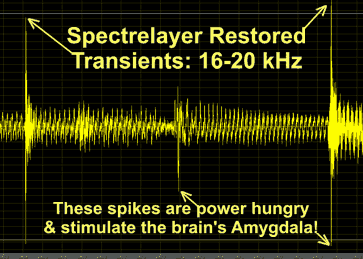
Spectrelayer restores harmonics that have been lost or diminished, &
reconstructs transients. Both often have high-frequency signal
components that look like signal spikes (See scope image below). 16 bits is obviously the
coding limit. That's what's recorded. However, of the people who
have high-end D-->A
converters that leverage oversampling - an interesting side effect
often occurs. This involves the math generated by the
oversampling process that interpolates & rebuilds the waveform
transients between the actual data samples of a high-frequency peak
- digitally. Such converters can create digital data that
exceeds 16 bits in value based on the interpolated shape of the wave
that was being described by the real adjacent peak samples in the 16
bit domain! And, if those converters have adequate
voltage-supplies - then they can create signal voltages that will
steer towards these higher transients! The next thing you'll notice is
that your power-amplifier is producing, I.E: 200+watt
momentary transients instead of the 100-watts that a lesser D-->A
converter would have demanded. Your tweeters will know it's there.
But will you? Only the best hearing can detect the differences. Perhaps
your's!
Q:
Does Spectrelayer sound good on streaming platforms.
A:
Spectrelayer shines on streaming platforms - louder and clearer than
the loudest recorded traditional music! This fact almost seems
counterintuitive because Spectrelayer'd tracks are not as loud as
their source originals. The extreme irony is that streaming-music
services look at the overall loudness of each track and reduce the
volume of that track in order to maintain a median loudness profile.
Because Spectrelayer'd tracks are less loud on average - they are
penalized less (sometimes not at all)! And, because Spectrelayer'd
audio has an improved dynamic range - all of those transients that
make the music sound better make it through the streaming loudness
algorithm unscathed! I.E: A "super-loud" studio release that
averages -8dB LUFS would get attenuated about 6dB with most
streaming services to achieve the industry target volume of -14dB
LUFS. The SAME material in Spectrelayer'd form may realistically
average -14dB LUFS as-is. This means the streaming service
would not attenuate that Spectrelayer'd track at all - and the
entirety of the dynamic range would be streamed! The result
would be a fantastically better sound - completely unimpaired by the
streaming service! Compared to Spectrelayer in that context -
the original would sound pale, flat & lifeless. A quick note: The
examples on the opening page of this website (original &
Spectrelayer'd) sound very much like they would on a streaming
service because those levels have been adjusted to approximate for
loudness.
Q:
The demo files on the Overview page seem to have varying sonic
qualities
among the different Spectrelayer'd versions. Why is that?
A:
 There are (3) reasons. Spectrelayer's settings can be set from mild
to aggressive during postprocessing. Those files showcase the range.
Each studio that produced the source recordings made each album with
a sonic signature resulting from the mastering pipeline each was
forged within. In
addition, some of the source files are recorded better than others.
While Spectrelayer can improve poorly mastered files dramatically,
the general rule is that the better the source - the better the Spectrelayer'd result. I.E: The Metallica demo was from a severely
damaged, loudness-war casualty. The Spectrelayer'd version is much
better but the severe compression & distortion of the original
didn't leave much good data left for data recovery - as the original
file was so damaged to start with. The Phil Collins demo original
(on the other hand) is so well recorded that it typifies the
excellence possible with conventional mastering. Where Spectrelayer
shines in post-processing such a file is the manipulation of a
number of sonic parameters that the brain cues upon. No human
engineer can track all of those parameters for optimization during
the original mastering. Spectrelayer can; -& effectively rebuilds
the waveform - leveraging what the system "knows" sounds good to the
human brain. Same track; - Different emphasis on the sonic spectrum
& dynamics. Early on it dawned on me that there are
components to sound that human-hearing may not be adept at detecting
on a conscious level. This is true about light & the perception of
color so why should we think we hear in the best possible schema,
either? All that rumination got me thinking: "If we could find a way
to process subtle properties of the audio as certain creatures like
the mantis-shrimp process unique colors (perhaps with a specialized
AI); -THEN maybe a signal could be reconstituted combining
traditional with the newer processing schemas that sounds better
than the sum of the parts? And most people agree: Spectrelayer often
sounds substantially better than the source audio & would describe
the sound of Spectrelayer as "Je ne sais'quoi". There are (3) reasons. Spectrelayer's settings can be set from mild
to aggressive during postprocessing. Those files showcase the range.
Each studio that produced the source recordings made each album with
a sonic signature resulting from the mastering pipeline each was
forged within. In
addition, some of the source files are recorded better than others.
While Spectrelayer can improve poorly mastered files dramatically,
the general rule is that the better the source - the better the Spectrelayer'd result. I.E: The Metallica demo was from a severely
damaged, loudness-war casualty. The Spectrelayer'd version is much
better but the severe compression & distortion of the original
didn't leave much good data left for data recovery - as the original
file was so damaged to start with. The Phil Collins demo original
(on the other hand) is so well recorded that it typifies the
excellence possible with conventional mastering. Where Spectrelayer
shines in post-processing such a file is the manipulation of a
number of sonic parameters that the brain cues upon. No human
engineer can track all of those parameters for optimization during
the original mastering. Spectrelayer can; -& effectively rebuilds
the waveform - leveraging what the system "knows" sounds good to the
human brain. Same track; - Different emphasis on the sonic spectrum
& dynamics. Early on it dawned on me that there are
components to sound that human-hearing may not be adept at detecting
on a conscious level. This is true about light & the perception of
color so why should we think we hear in the best possible schema,
either? All that rumination got me thinking: "If we could find a way
to process subtle properties of the audio as certain creatures like
the mantis-shrimp process unique colors (perhaps with a specialized
AI); -THEN maybe a signal could be reconstituted combining
traditional with the newer processing schemas that sounds better
than the sum of the parts? And most people agree: Spectrelayer often
sounds substantially better than the source audio & would describe
the sound of Spectrelayer as "Je ne sais'quoi".
Q:
The Spectrelayer'd versions seem to have a slight tonality
bump on the extremely low & high ends? Why is that?
A:
The may be several reasons you are hearing higher levels on the
spectrum ends. The primary reason is that the extreme ends of the
spectrum are where most weaker-tier components reveal their limits
in their playback signature. Many loudspeakers roll off the
high frequencies abnormally - dulling the upper harmonics (hello
Bose). Sadly - many microphones also do this - compounding the
error between mastering and playback! The same is true about the low
end - but Spectrelayer also filters out material under 20Hz to
prevent power-robbing infrasonics from creeping thru. Because
Spectrelayer preserves bit-depth to reproduce nuances - there is
often data available to describe the subtleties in the dynamics of
the low & high end that the ear can indeed resolve if the recording
contains these cues. It's better to cut too little than too much.
Spectrelayer is comprehensive regarding these factors & takes steps
to work these detailed nuances into the mix while making every
accommodation for the common shortfalls of many consumer audio
devices. This approach has (2) effects: People hear highs & lows
with better detail & clarity than ever before in recorded material;
-& audio systems that may normally suffer from internal limits -
sound better than usual. If your sound system already resolves
the ends of the spectrum with great clarity - then simply turning
back the respective tone controls will provide any attenuation you
need.
Q:
Does special pricing exist for certain types of musical material to
be "Spectrelayer'd"?
A:
Yes. Discounts for Exceptional & Humanitarian Project Ventures ...
I.E: "We Are the World" genres.
If you are involved in a project that has humanitarian merit such as
projects that support charities, or are focused on the betterment of
humanity via altruism (even if you are merely encouraging the
actions of such in lyric); -a special discount rate structure may be
available to process your audio via Spectrelayer. Please reach out
via e-mail & explain fully what you are doing. The savings could be
substantial. This is especially true for bands & art-centric
organizations that encourage charitable & responsible life choices.
Spectrelayer would like to help you shine! Savings of up to 80%
are available as are "Pay Us Later" opportunities based on the merit
of each track processed.
Q:
How much improvement can Spectrelayer bring to badly recorded
tracks?
A:
Every situation depends on a large number of factors. Briefly - it
depends on the quality of the source file. As a rule-of-thumb:
Sow's-ears are occasionally made into silk-purses; -But ckicken-sh!t
can never be made into chicken-soup.
Q:
I noticed the demos on the website are in 44.1kHz at 16 bits. If I
have my audio files Spectrelayer'd, do other end-format options
exist like 96 kHz at 32 bits?
A:
Yes. Generally speaking - the client can request any common lossless
format. However, keep in mind that - the chain is only as strong as
its weakest link. See previous comment.
Q:
It has been rumored that the Spectrelayer schema was developed -in
part- to leverage the Cannabidiol systems of the brain. Is
Spectrelayer electronic THC?
 A:
This rumor is predicated
on a tid-bit of truth. However, the bigger picture is that Spectrelayer
was designed to affect several centers of the brain involved in
sound & music processing. And I say "Sound & Music" because,
technically - they're not exactly the same mechanism. You can
imagine these centers of the brain each as a "layer" that the
Spectrelayer schema applies strategy to. The most obvious is the
amygdala. If you've ever been awakened by a loud noise that made
your heart pound & made you feel like you had been drinking
overly-strong espresso ... that's the amygdala. In less
intense situations - the amygdala adds a sense of
excited-appreciation - such as when you get surprised by a birthday
party or benefit from unexpected luck. Certain sound patterns
can trigger it repeatedly & Spectrelayer is attuned to doing so when
possible. The next layer of mental processing Spectrelayer is adept
at triggering is the sensation that comes with being able to clearly
recognize & sort multiple sounds simultaneously. This processing is
often amplified in many people while using marijuana recreationally.
The question arose: "What's happening in the brain while a person is
experiencing this?". To make a long story short, THC changes the
propagation speed of synaptic firing - stretching out the period of
time that virtual circuits (called strange attractors) exist in the
brain. Higher brain centers therefore have more time to examine
these signals before they degrade & this creates the sensation of
hyper-perception. Because this sensation is often connected to music
processing & the common experience is one of extreme pleasure while
listening - the question that arose was: "Can a similar effect on
the music-processing centers of the brain be done by restoring the
sound field to a better approximation of real world audio - without
THC?". I believe the answer is "Yes" & Spectrelayer attempts
this with an active equalization process combined with extremely
tight dynamic range control. These "layers" of processing are why
music encoded with Spectrelayer is designed to be played back
loudly. It's NOT about being continuously "loud". That would be
uncomfortable. What it's about is having that volume control turned
up so that the amplifier can deliver the rarer, moment to moment
peaks (which are often 10-1000 times briefer & more powerful) needed
to generate these auditory conditions.
In summary: These strategies work synergistically with the other
aspects of the Spectrelayer process & are designed to improve the
listening experience - never degrade it. Also - because Spectrelayer
works with the sound-processing part of the brain - it cannot
emulate any other effect of THC. So, if your long-haired friend
"Percy" asks: No, you cannot get stoned merely by listening to Spectrelayer'd content! However, rumor has it - that in those
places where doing such is lawful - combining THC with Spectrelayer'd audio "...takes you to a place". And that's
all I can say about that. A:
This rumor is predicated
on a tid-bit of truth. However, the bigger picture is that Spectrelayer
was designed to affect several centers of the brain involved in
sound & music processing. And I say "Sound & Music" because,
technically - they're not exactly the same mechanism. You can
imagine these centers of the brain each as a "layer" that the
Spectrelayer schema applies strategy to. The most obvious is the
amygdala. If you've ever been awakened by a loud noise that made
your heart pound & made you feel like you had been drinking
overly-strong espresso ... that's the amygdala. In less
intense situations - the amygdala adds a sense of
excited-appreciation - such as when you get surprised by a birthday
party or benefit from unexpected luck. Certain sound patterns
can trigger it repeatedly & Spectrelayer is attuned to doing so when
possible. The next layer of mental processing Spectrelayer is adept
at triggering is the sensation that comes with being able to clearly
recognize & sort multiple sounds simultaneously. This processing is
often amplified in many people while using marijuana recreationally.
The question arose: "What's happening in the brain while a person is
experiencing this?". To make a long story short, THC changes the
propagation speed of synaptic firing - stretching out the period of
time that virtual circuits (called strange attractors) exist in the
brain. Higher brain centers therefore have more time to examine
these signals before they degrade & this creates the sensation of
hyper-perception. Because this sensation is often connected to music
processing & the common experience is one of extreme pleasure while
listening - the question that arose was: "Can a similar effect on
the music-processing centers of the brain be done by restoring the
sound field to a better approximation of real world audio - without
THC?". I believe the answer is "Yes" & Spectrelayer attempts
this with an active equalization process combined with extremely
tight dynamic range control. These "layers" of processing are why
music encoded with Spectrelayer is designed to be played back
loudly. It's NOT about being continuously "loud". That would be
uncomfortable. What it's about is having that volume control turned
up so that the amplifier can deliver the rarer, moment to moment
peaks (which are often 10-1000 times briefer & more powerful) needed
to generate these auditory conditions.
In summary: These strategies work synergistically with the other
aspects of the Spectrelayer process & are designed to improve the
listening experience - never degrade it. Also - because Spectrelayer
works with the sound-processing part of the brain - it cannot
emulate any other effect of THC. So, if your long-haired friend
"Percy" asks: No, you cannot get stoned merely by listening to Spectrelayer'd content! However, rumor has it - that in those
places where doing such is lawful - combining THC with Spectrelayer'd audio "...takes you to a place". And that's
all I can say about that.
Q:
What's the AI thing?
A:

I have a question for some "Traditional" Mastering Engineers:

The Best of Both Worlds
(Sarcasm Warning):
 So,
it is true that Spectrelayer'd content tends to be 5-10 dB lower on
average in perceived loudness than its "loudness-war" damaged
counterparts. In order to restore the extreme detail that makes
music musical, Spectrelayer reallocated several bits of data per
sample to encode the finesse, spacial cues & clarity of the music. This
restoration of detail is WHY Spectrelayer is quieter. You see, a
digital audio data stream only has so much data by which it
describes the moment to moment sound. Spectrelayer chose to allocate
those bits for detail - instead of continuous, unnatural, loudness.
However, seemingly unknown to many people in the recording industry
& radio broadcasting; -There IS a high-tech device capable of
making Spectrelayer'd content sound louder WITHOUT
SACRIFICING DETAIL OR SOUND QUALITY. That's right! A technology
exists that allows Spectrelayer to eat its loudness cake & have it
too! It also turns out that this technology has been around
for quite some time. Perhaps it's on your music device, too! On
whatever device you're using to play back your music, look for a
controller with the letters nearby it's location that spell the
obscure term: "VOLUME". This "VOLUME" controller
may be a knob, slider of [^] like graphic. It turns out that
adjusting this "VOLUME" control can make Spectrelayer content
louder WITHOUT sacrificing the sonic clarity of
the music! It's my assertion that had the recording industry known
about this "VOLUME" controller that much of the entire
loudness war could have been prevented & many, many recordings that
were damaged by engineers probably could have been preserved! If
only the recording industry had been able to limit its overly-loud
recordings to distribution to radio-stations, perhaps as special
release versions (as if anything like that could occur)!
Unfortunately, recordings damaged by the loudness war can't be
"fixed" by turning that amazing "VOLUME" knob in the other direction
because, sadly, the musical detail was sacrificed in making the
recording unnaturally "loud" to begin with. It's been observed that:
"You can't UNburn a cake by freezing it.". Fortunately,
Spectrelayer can, proverbially, "recycle the old cake to make a
better one using a brilliant baker named 'AI''! So,
it is true that Spectrelayer'd content tends to be 5-10 dB lower on
average in perceived loudness than its "loudness-war" damaged
counterparts. In order to restore the extreme detail that makes
music musical, Spectrelayer reallocated several bits of data per
sample to encode the finesse, spacial cues & clarity of the music. This
restoration of detail is WHY Spectrelayer is quieter. You see, a
digital audio data stream only has so much data by which it
describes the moment to moment sound. Spectrelayer chose to allocate
those bits for detail - instead of continuous, unnatural, loudness.
However, seemingly unknown to many people in the recording industry
& radio broadcasting; -There IS a high-tech device capable of
making Spectrelayer'd content sound louder WITHOUT
SACRIFICING DETAIL OR SOUND QUALITY. That's right! A technology
exists that allows Spectrelayer to eat its loudness cake & have it
too! It also turns out that this technology has been around
for quite some time. Perhaps it's on your music device, too! On
whatever device you're using to play back your music, look for a
controller with the letters nearby it's location that spell the
obscure term: "VOLUME". This "VOLUME" controller
may be a knob, slider of [^] like graphic. It turns out that
adjusting this "VOLUME" control can make Spectrelayer content
louder WITHOUT sacrificing the sonic clarity of
the music! It's my assertion that had the recording industry known
about this "VOLUME" controller that much of the entire
loudness war could have been prevented & many, many recordings that
were damaged by engineers probably could have been preserved! If
only the recording industry had been able to limit its overly-loud
recordings to distribution to radio-stations, perhaps as special
release versions (as if anything like that could occur)!
Unfortunately, recordings damaged by the loudness war can't be
"fixed" by turning that amazing "VOLUME" knob in the other direction
because, sadly, the musical detail was sacrificed in making the
recording unnaturally "loud" to begin with. It's been observed that:
"You can't UNburn a cake by freezing it.". Fortunately,
Spectrelayer can, proverbially, "recycle the old cake to make a
better one using a brilliant baker named 'AI''!
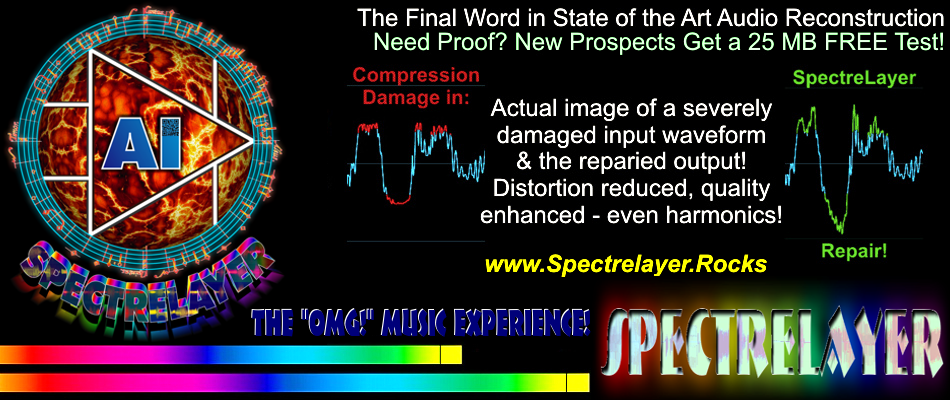
Since the best proof is sure proof: As a 1-time free offer:
Professionals may E-mail a LOSSLESS
test stereo audio file (one you have copyright/s to) up to 25MB
in size (formatted as WAV, FLAC, or APE) & it will be processed with Spectrelayer
ASAP &
the result sent back to you as an AAC file attachment. At that point - you'll have
the original source and the Spectrelayer'd result to compare for
yourself. It's the ONLY way to be absolutely convinced with proof
positive! And: Be sure to adjust the average playback
loudness using a
standardized loudness metering device in order to avoid the
loudness-war perceptual trap. After all: If you can't believe your
own ears ...
|