HD Options!
Need to resize the page? Windows/Linux/Chrome use:[CTRL]w.[+]/[-]
keys. Apple:w.[+]/[-]
Optimized
Advanced information processing is leading a media revolution!
Leverage its best!
Spectrelayer
is a high-end, revolutionary audio optimization, restoration & processing technology
service
that is applied at the very end-point of the
mastering process. Designed for production standards
that demand
the ultimate in sound quality; - Spectrelayer's proprietary AI-complementary
processing "knows" what sounds good to the ear & also
repairs several types of severe distortion; - raising the bar
called "sonic excellence"! Audiophiles agree! And now, studios
can affordably leverage the Spectrelayer service to give that jenesais'quoi
to their commercial releases!
Professional Courtesy:
If you are seeking information about Steinberg's or Sony's audio
tools spelled/pronounced: SpectraLayers;
-Please visit their respective websites.
NOW HEAR THIS!
The Audio Demo Clips
Below are in AAC & FLAC Audio Formats for Widest Compatibility
For critical listening demo purposes, studio headphones
are strongly suggested such as the Sony MDR-7506's, Beyerdynamic 770's or
Audio-Technica ATH-M50x's.
Hi-end consumer audio is also a good sound source.
Not suggested are phones,
tablets, monaural or cheap production Bluetooth devices, nor low-end
television monitors.
Spectrelayer also offers sound
signature styles. I.E: The Spectrelayer'd demo
tracks above are in variants of a style called "Digital Vinyl".
The improvements are real!
The technology is proprietary! And a human set of ears optimizes it
all!
Spectrelayer processing does
many things - and among them, it identifies "aberrant spectral
composition" - & applies a multilayered, continuous correction -
dynamically across numerous tonal bands. Spectrelayer also
identifies & corrects acoustic shortfalls & errors in the end waveform and then uses
extremely sophisticated processing to correct, mask or minimize many
of those shortfalls.
These sonic-shortfalls occur most often when signal processing in the
mastering pipeline malforms data & creates digital information that
does not conform mathematically to a real world wave function.
Spectrelayer's AI is particularly adept at detecting where such changes need to be
made, in what degree & across a multitude of parameters
(Spectrelayer is not a pure AI, but a powerful hybrid).
Spectrelayer, is not a replacement for competent mastering. To the
contrary: Spectrelayer presumes audio engineers acted
with volition. So: The stronger certain signal-components are;
-The more likely these are there with intent & Spectrelayer
will be less inclined to affect them. Applied at the end
of the mastering process; -Spectrelayer is a fine finishing
artisan - NOT a "music-mill"!
YEAH: It's OK to
be Critical!
Due to the
extreme quality differences between the
Original/Spectrelayer'd
demos above - it would be rational to ask whether or not the
examples chosen have been adversely 'doctored' to make the
originals seem lower quality than they are in reality. And
that's a good question to have. Certainly less-than-ethical
entities might do that very thing in order to bolster the
perceived gains introduced by their products. After
all, if you go to most mastering related websites & listen
to the comparisons - what you'll notice in many cases is
that the "AFTER" demos are LOUDER. Simply being louder can
trick most listeners into believing the louder track sounds
better - even if the only difference between
Before/After is overall loudness! This form of bias
toward merely louder sounding content can be extremely
deceiving It's the reason why so much of the "Loudness War"
happened. Spectrelayer'd tracks are more dynamic - but
generally less "loud" - but it can be difficult to judge sometimes which
is why RMS levels were chosen in this context.
Some
of the biggest purveyors of proverbial "snake-oil" in audio
circles are well polished & well funded in the background.
One of the latest scandals has to do with a process called
MQA. A number of independent audio enthusiasts have called
it a multimillion dollar scam and
the evidence is piling up against it
& damaging professional reputations as it does so!
Of course - audio has always seemingly been plagued with scams
that seem to take advantage of the over-inflated egos of
certain people who claim to have ears so golden that they
can hear the fine ruffles of
The Emperor's New Clothes.
These scams range from nonsense
devices that are designed to shave the edges from compact
discs
to
stratospherically-priced cables
to endless variations of
"Hi-Res" Audio schemes
that all purport to use more bits &
higher sampling rates than the CD Standard of 16bits/44.1kHz
per channel (as if that standard is somehow antiquated or
lacking). If you lay aside the promoting testimonies
of people who have personalities likely defined by the
DSM;
- ALL of these scams have (1) commonality: The average
person simply can't hear the alleged improvement/s that are
extolled by the promoters of these gimmicks or by the
soft-personalities of those people whom the
placebo
effect
also works wonders. If you need
to strain to hear the improvement than it's not real.
Furthermore -
test
equipment can provide evidence
if such claims are false. Spectrelayer, on the other hand
is a process where the differences between source & output
virtually jump out at the listener. Analysis of the same
shows clear differences in the signals that are much more
complex than mere loudness variances! Most people's jaws
drop open when hearing the Spectrelayer'd version of audio
contrasted to its source. If you haven't yet
taken the time to audition the examples above
- now is a good time.
Tech Stuff about
the Processing of the Comparison's
Above:
The ONLY processing done
above on the original files for the sake of accurate A / B
comparisons was a linear gain
adjustment applied once across each original waveform - used to make sure the
average RMS loudness between the
original tracks & Spectrelayer'd versions was equivalent. Because of
dynamic range differences - it's not possible to perfectly match
peak for peak, - so the AVERAGE loudness was set to target
within 1dB RMS-averaged differences between original &
Spectrelayer'd examples (& the
ORIGINAL was
skewed toward the louder of the two on average in order to keep the bar for Spectrelayer
higher due to how
loudness differences affect perception).
This observation is astonishing because Spectrelayer has higher peak
values but demands less relative energy for overall sonic
reproduction.
So, to
reiterate: All of the original demo
tracks are on par with the Spectrelayer'd versions with averaged RMS
loudness levels (the originals having a slightly higher average RMS value).
If you measure in LUFS units, you may want to recalibrate
the FLAC versions into LUFS. If you download the FLAC
versions into a DAW - you can see precisely
what I am describing as well as polling your DAW for waveform stats
to confirm that the numbers are as described (Although, the Spectrelayer'd versions' dynamic
range is superior in each case). This is because - that
when recordings are made arbitrarily louder, the detail is obscured;
-& Spectrelayer recovers
that detail when it restores more appropriate dynamics. But, of
course - all this bias in favor of Spectrelayer is moot if things are not as described.
I.E:
An Original
Signal Metallica -
Cyanide
Mouse
over to see the loudness reduction used for
comparisons
Spectrelayer
Version
Still uses full scale for peaks but not nearly as loud on
average!
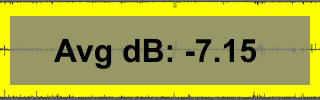
Top cell:
Original Signal w. Average Loudness = -7.15 dB RMS.
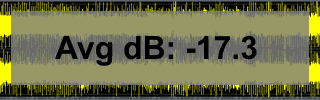
Middle:
Spectrelayer version of same signal is more dynamic but less
loud averaging -17.3 dB RMS.
I.E:
In the demonstration's above, the louder (original) is reduced in gain in order to match the Spectrelayer'd
signal's RMS (an objective measurement) loudness for purposes of A / B comparisons.
Of interest is that during Spectrelayer development a form of non-linear
compression distortion was
identified that almost all audio recording & playback methods
introduce due to common mechanics of audio transducer design. Spectrelayer
can effectively counter that distortion which is one reason why
Spectrelayer sounds more "real". Additionally, destructive compression distortion is one of the
worst offenders introduced during traditional mastering because it
spawns spurious harmonics in transducers. Spectrelayer technology can effectively
undo much of this including restoring more accurate harmonics lost in
the mutilated part of the signal.
The result of using Spectrelayer is a level of sonic clarity -
as well as lowered distortion levels and increased dynamics that did
not previously exist in any previous commercial release of the recording.
Spectrelayer quite literally - rebuilds the waveform using the
source audio only as the guide (& a massive set of heuristics &
constraining algorithms to determine the most probable end waveform
shape based on the control parameters template set by the managing engineer). Spectrelayer
comprehensively works in an analog with how the brain 'hears' &
unapologetically delivers on every advantage that the digital audio
format originally promised! And, of course - if there is some
parameter you need to have adjusted (I.E: Warmer or crisper sound modeling);
- Ask! For example, the Spectrelayer tonality-template of the audio demo
examples above is called the: "Digital Vinyl Signature"
(although Spectrelayer is not suited to literal vinyl transfer due
to transients that even challenge D2A converters)! It's been
observed: "Spectrelayer is not as 'Loud'". Well, compared to what?
The fool's-errand, called the "loudness
war" put sonic-clarity & musical detail on the altar of
sacrifice and used those valuable portions of the digital signal
(which could have relayed quality, finesse & musicality) - to
instead, maximize the perceived loudness of the audio signal (often
compressed & distorted to sound 'louder'). This fool's errand
was initially driven by marketing - using radio broadcasting as the mode of selling music to the masses & wanted
their material to sound "louder" on the radio. And since they could not
control the "GAIN" at the radio station - the half-assery of
short-sightedness reasoned that a similar end goal could be
accomplished by simply maximizing recorded volume levels on the
media itself.
The half-assery caught on. And the "loudness war" was birthed at
the price of musical quality!
Spectrelayer, which is not as "Loud" on Digital Media - is Actually Louder
& Clearer when Streaming! How?
The extreme irony is that
streaming-music services look at the overall loudness of each track
and reduce the volume of that track prior to streaming it in order to maintain a median
loudness profile. Because Spectrelayer'd tracks are less loud on
average - they are attenuated less (sometimes not at all)! And,
because Spectrelayer'd audio has an improved dynamic range -
those stunning transients that make the music sound better also make it through
the streaming loudness algorithm - often unscathed! I.E: A "super-loud"
studio release that averaged -8dB LUFS would get attenuated about
6dB with most streaming services to achieve -14dB LUFS. The SAME
material in Spectrelayer'd form may realistically average -14dB
As-Is. This means the streaming service would not attenuate it at
all - and the entirety of the dynamic range would be streamed! The
result would be a fantastically better sound - completely unshackled
by the streaming service! A quick note: The examples above (original
& Spectrelayer'd) sound very much like they would on a streaming
service because those levels have been adjusted to approximate for
loudness. However, Spectrelayer strains older codecs like MP3 &
performs better with newer codecs such as AAC or OPUS, & loves
lossless!
Since the best proof is sure proof: As a 1-time free offer:
Professionals may
E-mail
a LOSSLESS
test stereo audio file (one you have copyright/s to) up to 25 MegaBytes
in size (formatted as WAV, FLAC, or APE) & it will be processed with
Spectrelayer, ASAP: and the result sent back to you as a file attachment. At that point - you'll have
the original source and the Spectrelayer'd result to compare for
yourself. It's the ONLY way to be absolutely convinced with proof
positive! And: Be sure to adjust the average playback
loudness using a
standardized loudness metering device
in order to avoid the
loudness-war perceptual trap. After all: Can you believe your
own ears?
Yin vs. Yang; - A Well Trained AI Does it Better!(An Editorial by the process developer):
You might
think that I would sing the marketing-song of sonic purity &
trueness to the original master recording in order to market
Spectrelayer. After all - isn't that what all of those other
companies say about their gimmicks? Well, there is a certain logic
to that marketing approach. However, Spectrelayer's claim is that it
makes a better sounding audio file than the original release. The
"rumor" is true: Spectrelayer
alters the sound (so much that the waveform is visibly different
when examined in a DAW)! That may seem like the ultimate sonic
heresy at the altar of the self-proclaimed "audiophile".
BUT, the gigantic fallacy that almost everyone falls prey to is the
presumption that
the mastering engineers chose all of the optimum settings as they
recorded, mixed & post-mastered the sound in the first place! If you
think the mastering engineers had halos & chose the best possible
mix parameters out of the ocean of permutations - then I can't
out-dogma you
-nor will I try. Spectrelayer uses machine hearing to
make a multitude of continuous adjustments during post-mastering & Spectrelayer'd audio sounds DIFFERENT
- BETTER
than the version the record label had originally slated for release.
And, most listeners agree that Spectrelayer sounds remarkably better than the
original source or pre-Spectrelayer'd version. But if you analyze the waveforms Spectrelayer
creates, - the so called "purists" may cry "foul"!
Vastly different EQ curves! Different dynamics! A relocated noise-floor
(sometimes higher)! But, let me ask:
"Where were the purists while the loudness war was destroying the
music in the 1st place?", eh? Perhaps they were too enamored
admiring the shine of some engineer's halos - to notice what their
ringing ears were telling them at the end of the mix? The
purists will likely tell you that Spectrelayer introduces types of
noise, tonal coloration & even distortion. And (being brutally
honest), by showing you charts, graphs & numbers
- they'll be able to PROVE IT (but, not with
listening comparisons)! And HERE's the critical distinction: WHY does Spectrelayer sound
so much better to most ears - even when certain statistics &
technical measurements may accuse the methodology of the process? It's because Spectrelayer's benefits far
outweigh its detractions - by magnitudes(Yin vs. Yang). I once considered
myself a "purist" - ever watching the noise-floor & signal THD
levels, IM distortion & never ever let the digital peak level hit
the 0dB marker (Oh! The humanity!); -& don't gasp too
loudly, but I think I derided the artifacts of a noise-gate opening on
several occasions! But, then I heard what certain machine's
speculate humans prefer to hear based on how the human brain
perceives audio &, - those intelligent algorithms nailed it! And, as
a sonic purist; - That's humbling.
You see, there are now (2)
very different approaches to making great sound. The conventional
involves ultra-tight control of every aspect of the recorded signal.
It's very "left-brained" & mathematically solid. It has an elegant
beauty that appeals to the perfectionist part of every audio
engineer. And that philosophy has made fantastic recordings
possible and is absolutely necessary because the better it is
executed - the better the next approach works. See, there is an emerging body of tech (which builds
upon the former) - intelligent algorithms that work with multiple
parameters at once while treating the signal with a "brute-force
machine-philosophy" concluding that "the end justifies the means".
These networks don't care about the sanctity of test signals if the
style-template & processing schema suggests that such needs to be
adjusted to "sound better" in the current context! This drives
conventional engineers to nail-biting. Trying to follow the logic of
a network that can control countless parameters as sonic processing
nodes spring into
and out
of existence dynamically - is like trying to
track a scurry of squirrels. "Orthodoxy was violated...",
observes some purist. "Yes,
-but did you hear that fantastic output compared with the input?", replies
someone with ears (Because, if it sounds better, - it sounds ... better)!
So, remember this: "The
pursuit of the perfect is the enemy of the good." - General
George Patton.
And I think the quote from a decorated war general is apt here.
Because, despite the casualty of an occasional "purist's audiophile
religion", - Spectrelayer, has not only won the loudness war - but
has allowed some of its casualties to be brought back from the
dead using its AI! Furthermore - & more importantly: Spectrelayer makes most
recordings sound better - even if they were not casualties of the
loudness war! And you don't need to take my word for it! Hear it for
yourself! And like any technology, -Spectrelayer is constantly
improving which means that a shortfall today may be addressed
tomorrow.
If you're an engineer who has suggestions for this page -
PLEASE send a message from our CONTACT page (link at page
top). Constructive commentary is always welcome!
Spectrelayer - the FINAL
Word:
Spectrelayer
is the proverbial icing on the cake. The process is designed to be
the very last applied to the audio prior to commercial release. In
other words: Spectrelayer touches the signal, last! This will
allow the skilled brilliance of competent audio mastering engineers
to do their best ... to "make it perfect"; -- And then the final
stereo audio is submitted for Spectrelayer'ing. When the
Spectrelayer'd version returns - it is compared against the source
it was made from by the client. And then
payment is made for the Spectrelayer'd
versions that will be usedin the commercial release or
re-release.
And, any release that utilizes Spectrelayer in any capacity must
bear the Spectrelayer authorized logo in or on the media packaging
(unless otherwise specified). It's that straightforward, safe &
simple.
Jenesais'quoi Consulting:
Using AI & Proprietary Systems to Assist Traditional Sound-Staging
Spectrelayer
is so tremendously effective at optimizing sound from any source -
that it should come as no surprise that what has been learned can be
worked into traditional sound systems, stages & auditoriums.
This is a premium service. Although the Spectrelayer process is
currently too tech-heavy to be implemented in real-time; -The AI has
allowed some insight into common problems and how more traditional
technologies can be brought to bear on problem solving &
sound-quality optimization. In simple terms: If we can show the
client where a peril lies - then it's possible to avoid a situation
that may become a problem. And eliminating problems up front removes
the need to fix what was prevented in the 1st place! One thing that
Spectrelayer offers is a very unique form of hindsight; - a form
than can be turned into foresight (at least regarding a number of
issues).
So, whether
you're designing a home theater, performance auditorium, or
customized "man-cave" - we may be able to provide some tips,
solutions & near-miracles depending on your need. Contracting
Jenesais'quoi Consulting will require a $5000 retainer at least 30
days in advance. Due to the current state of global unrest -
services are offered only in North America unless otherwise
arranged.
Attention: Law
Enforcement:
Introducing "Tattler"!
Spectrelayer is so
tremendously effective at repairing damaged audio that a customized
speech processing mode can be
used as part of a forensic reconstruction process called
TATTLER.
TATTLER
is unlike traditional sound recovery technologies. Still in
the
Beta
stage of development, -
TATTLER
services are extremely reasonably priced starting at
$250 CDN for up to 2-minutes of reconstruction (rounded up) for finalized media. Whether
you're an agency needing answers or merely somebody who
wants to know what the kids were screaming into the answering
machine; - Send an e-mail explaining your need and you'll receive a
response instructing you on how to send your media electronically.
Let's be clear: There has
never been anything quite like Spectrelayer processing and your own
ears can
prove it to you! Hear a 1-time-FREE demo of the process on
material you provide! TATTLER demonstrations are available as
well. In either case, -you'll hear for yourself and get
to compare "A" with "B". After all -- if you can't believe
your own ears ... Fair
enough? E-mail us with your needs!
Details on getting this free demo service: Send the file as
an e-mail attachment (Under 25MB in size formatted as RAW PCM or
FLAC please) & the reprocessed audio will be sent in a reply message
attachment in AAC format. See CONTACT link above.
 w.
[+]/[-]
w.
[+]/[-]







.svg.png) Optimized
Optimized Some
of the biggest purveyors of proverbial "snake-oil" in audio
circles are well polished & well funded in the background.
One of the latest scandals has to do with a process called
MQA. A number of independent audio enthusiasts have called
it a multimillion dollar scam and
Some
of the biggest purveyors of proverbial "snake-oil" in audio
circles are well polished & well funded in the background.
One of the latest scandals has to do with a process called
MQA. A number of independent audio enthusiasts have called
it a multimillion dollar scam and
 Spectrelayer - the FINAL
Word:
Spectrelayer - the FINAL
Word: